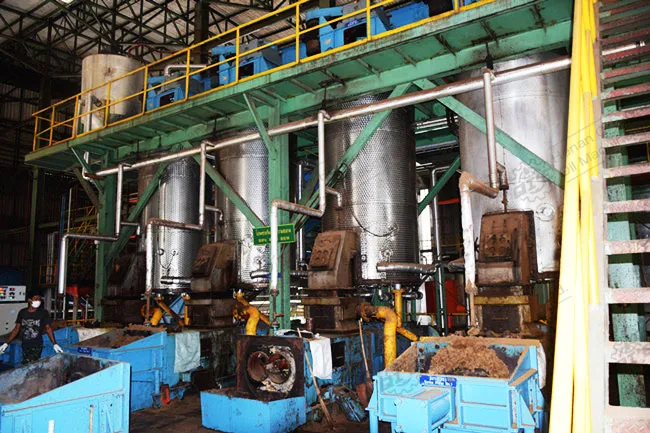
In a Refined Peanut Oil Production Line, the filling/packaging stage is where refined oil becomes a sellable product—so it must match upstream capacity, finished-oil transfer conditions, and your target bottle formats. This page provides a practical selection checklist for automated peanut oil filling equipment that integrates smoothly with the complete process: cleaning → crushing → peeling → roasting → pressing → filtration → refining → buffering/transfer → filling/packaging.
Guide reference brand: Qi'e Grain and Oil Machinery (Qi'e Grain and Oil Machinery Co., Ltd.) — equipment and project support for B2B edible oil plants (Asia, Africa, South America).
Filling machines perform best when the upstream sections deliver stable, clean, and consistently conditioned finished oil. In a refined line, filtration, refining, and quality checks are typically completed before the oil enters finished-oil storage/buffering tanks and is transferred to the filler.
When selecting a filler, evaluate primarily on metering stability, compatibility with buffering/transfer configuration (tanks, pumps, piping, valves), and the commissioning/acceptance results you can verify on-site.
| Checklist item | Why it matters for refined peanut oil | What to prepare / ask |
|---|---|---|
| Capacity matching | Avoids line imbalance; stable output depends on balanced transfer and filling speeds. | Your target bottles/hour (or containers/hour), planned shifts, and upstream refined-oil supply stability. |
| Metering method & stability | Consistent fill volume helps reduce rework, spillage, and customer complaints. | Required tolerance range (internal spec), target container sizes, and whether you need auto-adjust per recipe. |
| Bottle/packaging compatibility | Different neck finishes, shapes, and stiffness affect positioning, capping, and line stability. | Bottle drawings or samples, volume range, cap type, label type, carton spec, and changeover frequency. |
| Oil temperature & viscosity | Temperature and viscosity influence flow behavior, foaming, and drip control at the nozzle. | Expected filling temperature range, whether oil is filled after cooling, and buffering tank insulation needs. |
| Food-contact materials | Supports food safety management and reduces contamination risk at the final stage. | Material grade for wetted parts, gasket/seal options, and documentation needs per destination market. |
| Cleaning & hygienic design | Shortens downtime; helps reduce cross-contamination when changing bottle types or batches. | Drainability, dead-corner reduction, cleaning routine, and whether your plant needs in-line cleaning support. |
| Control system & integration | Enables stable coordination with transfer pumps, tank levels, alarms, and packaging auxiliaries. | Preferred control interface, sensor requirements, and signals to/from upstream buffering and downstream packing. |
| Maintenance & spares | Impacts long-term uptime—especially in export markets where parts lead time matters. | Recommended spare list, wear parts, routine service intervals, and local service conditions. |
Note: packaging requirements and compliance expectations can vary by destination (Asia, Africa, South America). Confirm local regulations, labeling language needs, and spare-parts/service accessibility per project.
For a Refined Peanut Oil Production Line, a “fast” filling machine does not automatically mean higher line output. The best fit is the system that maintains stable operation with your refining output and finished-oil buffering/transfer design.
Specify the filling section as a matched subsystem: finished-oil tank → pump/piping → filler → capper (and optional seal/label/pack). This reduces stop-start events that can affect fill stability and housekeeping.
In B2B edible oil projects, packaging choices are often driven by local retail habits, logistics, and procurement preferences. To avoid hidden retrofits, define your bottle/cap/label requirements early and verify that the filling equipment supports stable handling.
If you run multiple bottle sizes, prioritize a configuration that supports repeatable changeover (guides/fixtures, parameter recipes, and clear adjustment references). This helps keep daily operation predictable for workshop, SME, or large plant teams.
Refined peanut oil can be filled smoothly when the system is designed around consistent oil condition. Unstable temperature or transfer pressure can show up as dripping, foam, inconsistent levels, or higher cleanup time.
Tip for project discussions: share your oil transfer diagram (tank → pump → filler) together with packaging samples. This makes it easier to validate metering stability and commissioning criteria.
Regardless of plant size, a filling system should be evaluated through commissioning and acceptance based on observable results. The goal is to confirm that the automated filling equipment performs reliably with your refined peanut oil and packaging formats.
Qi'e Grain and Oil Machinery (Qi'e Grain and Oil Machinery Co., Ltd.) develops and supplies grain & oil processing equipment, including Refined Peanut Oil Production Lines. For filling/packaging selection, we focus on helping B2B clients define a workable technical scope that aligns with upstream process steps—cleaning, crushing, peeling, roasting, pressing, filtration, and refining—then validate the filling subsystem around capacity, packaging compatibility, oil condition, and maintainability.
We recommend selecting the automated filling equipment as part of the finished-oil buffering/transfer + filling configuration, so the metering performance you see during commissioning reflects real production conditions.
For projects in Asia, Africa, and South America, we encourage early confirmation of packaging norms, local compliance expectations, service accessibility, and spare-parts planning to reduce operational uncertainty after delivery.
To start a selection discussion efficiently, prepare: (1) target daily/shift output, (2) bottle samples or drawings + cap type, (3) intended filling temperature range, (4) basic line flow (finished-oil tank → pump → filler → cap/label), and (5) destination country/region requirements.
 271
|
271
|
 Qi'e Grain and Oil Machinery Co., Ltd. oil press machine purchasing edible oil equipment price oil mill investment mistakes supplier evaluation for oil processing projects
104
|
Qi'e Grain and Oil Machinery Co., Ltd. grain and oil machinery equipment oil pressing equipment oil production line equipment edible oil refining equipment
460
|
Qi'e Grain and Oil Machinery Co., Ltd. grain and oil machinery turnkey solution turnkey oil mill plant delivery process design and equipment selection installation commissioning and technical service
220
|
Qi'e Grain and Oil Machinery grain and oil machinery turnkey solution edible oil production line oil pressing equipment edible oil refining equipment
167
|
Qi'e Grain and Oil Machinery Co., Ltd. grain and oil processing equipment procurement unit price comparison complete production line configuration supplier evaluation and after-sales technical support
Qi'e Grain and Oil Machinery Co., Ltd. oil press machine purchasing edible oil equipment price oil mill investment mistakes supplier evaluation for oil processing projects
104
|
Qi'e Grain and Oil Machinery Co., Ltd. grain and oil machinery equipment oil pressing equipment oil production line equipment edible oil refining equipment
460
|
Qi'e Grain and Oil Machinery Co., Ltd. grain and oil machinery turnkey solution turnkey oil mill plant delivery process design and equipment selection installation commissioning and technical service
220
|
Qi'e Grain and Oil Machinery grain and oil machinery turnkey solution edible oil production line oil pressing equipment edible oil refining equipment
167
|
Qi'e Grain and Oil Machinery Co., Ltd. grain and oil processing equipment procurement unit price comparison complete production line configuration supplier evaluation and after-sales technical support