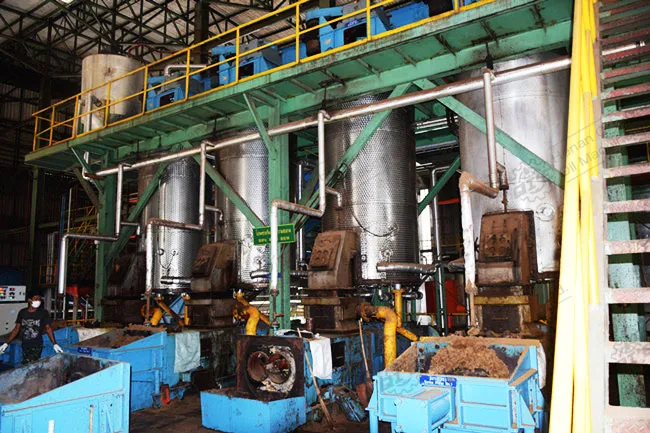
Selecting an edible oil production route is a strategic decision that affects product positioning, operating complexity, compliance, and long-term profitability. This page provides a structured comparison of cold pressing, hot pressing, and solvent extraction—with a focus on feedstock suitability, process flow, typical equipment configuration, oil quality outcomes, capacity planning, and operational impacts.
Qi'e Grain and Oil Machinery Co., Ltd. (企鹅集团) supplies oil pressing equipment, oil production lines, and edible oil refining equipment for B2B customers. We support process selection and configuration planning based on your raw materials, target market requirements, and investment scale.
| Dimension | Cold Pressing | Hot Pressing | Solvent Extraction |
|---|---|---|---|
| Typical positioning | Premium, “natural aroma” or quality-forward oils (depending on seed type and market) | Mainstream edible oils, balanced yield & flavor; common for many oilseeds | High-capacity, yield-focused industrial plants; often paired with refining |
| Feedstock fit | Sensitive to seed quality & cleanliness; works well when consistent raw material is available | Broad applicability; pre-treatment improves stability and press performance | Best for large volumes and materials where maximum oil recovery is prioritized |
| Core process steps | Cleaning → conditioning (low-temp) → pressing → filtration | Cleaning → crushing/flaking → cooking/roasting → pressing → filtration | Pre-treatment → extraction → desolventizing/toasting → miscella evaporation → solvent recovery |
| Oil quality implications | Often lighter processing; may retain more characteristic aroma depending on seed and parameters | Heat can enhance aroma for certain oils; may increase impurities requiring stronger downstream purification | Typically requires robust refining to meet edible standards and product specs |
| Capacity planning | Common in small-to-medium mills; scalability depends on press count and feeding logistics | Widely used from small to medium/large; robust for varied seeds and daily operation | More suitable for large continuous lines with stable supply and utility support |
| Operations & compliance | Simpler plant layout; easier startup/stop; lower process hazards | Moderate complexity; heat management and sanitation are key | Highest complexity; solvent safety, ventilation, recovery efficiency, and environmental controls are critical |
Note: final product quality and yield depend on seed variety, moisture, impurities, pre-treatment, operating parameters, and downstream refining—not on process name alone.
Typical outcomes: simpler plant setup and easier operation; capacity increases by adding presses and improving feeding/handling efficiency.
Typical outcomes: more robust for diverse feedstock; requires good heat and sanitation management to keep quality stable.
Operational note: solvent extraction requires stricter safety engineering, monitoring, and compliance controls. Plan early for plant layout, ventilation, explosion-proof requirements, and environmental management.
Exact configuration depends on seed type, desired throughput, and whether the project includes refining. Below is a practical view of common modules used in edible oil plants.
| Module | Cold Pressing | Hot Pressing | Solvent Extraction |
|---|---|---|---|
| Pre-cleaning | Required | Required | Required |
| Conditioning / Cooking | Low-temp conditioning | Cooking/roasting common | Conditioning for extraction stability |
| Core oil recovery | Screw press (single or multiple) | Screw press with stronger pre-treatment | Extractor + solvent recovery system |
| Oil clarification | Filtration/settling | Filtration/settling | Post-evaporation polishing + refining preparation |
| Refining (optional/required) | Optional based on market spec | Often applied for standard edible grades | Commonly required to meet product specs |
As a mechanical equipment manufacturer focused on grain and oil processing, Qi'e Grain and Oil Machinery Co., Ltd. provides equipment and technical support across pressing, extraction, and refining routes. Our approach is to clarify constraints first—raw material, target product, throughput, utilities, and compliance—then recommend a practical and maintainable configuration.
With these inputs, we can align process flow, equipment modules, and commissioning scope to your project reality—supporting a decision that fits both operations and long-term expansion.
Qi'e’s brand principles—people-oriented, quality-first, and service-focused—translate into practical engineering: stable lines, maintainable layouts, and process choices that match your feedstock and market goals.
 225
|
225
|
 rapeseed oil pretreatment process
rapeseed oil yield improvement
rapeseed seed cleaning and dehulling
rapeseed conditioning and cooking control
rapeseed flaking process optimization
376
|
Qi'e Grain and Oil Machinery Co., Ltd.
grain and oil processing project
equipment selection
price misconception
after-sales service
60
|
Qi'e Grain and Oil Machinery Co., Ltd.
edible oil refining equipment
degumming process
deacidification process
bleaching and deodorization
165
|
Qi'e Grain and Oil Machinery Co., Ltd.
grain and oil processing equipment procurement
unit price comparison
complete production line configuration
supplier evaluation and after-sales technical support
344
|
rice bran oil deacidification equipment
high-efficiency deacidification system
rice bran oil bleaching technology
energy-saving rice bran oil refining line
edible oil purification equipment
rapeseed oil pretreatment process
rapeseed oil yield improvement
rapeseed seed cleaning and dehulling
rapeseed conditioning and cooking control
rapeseed flaking process optimization
376
|
Qi'e Grain and Oil Machinery Co., Ltd.
grain and oil processing project
equipment selection
price misconception
after-sales service
60
|
Qi'e Grain and Oil Machinery Co., Ltd.
edible oil refining equipment
degumming process
deacidification process
bleaching and deodorization
165
|
Qi'e Grain and Oil Machinery Co., Ltd.
grain and oil processing equipment procurement
unit price comparison
complete production line configuration
supplier evaluation and after-sales technical support
344
|
rice bran oil deacidification equipment
high-efficiency deacidification system
rice bran oil bleaching technology
energy-saving rice bran oil refining line
edible oil purification equipment