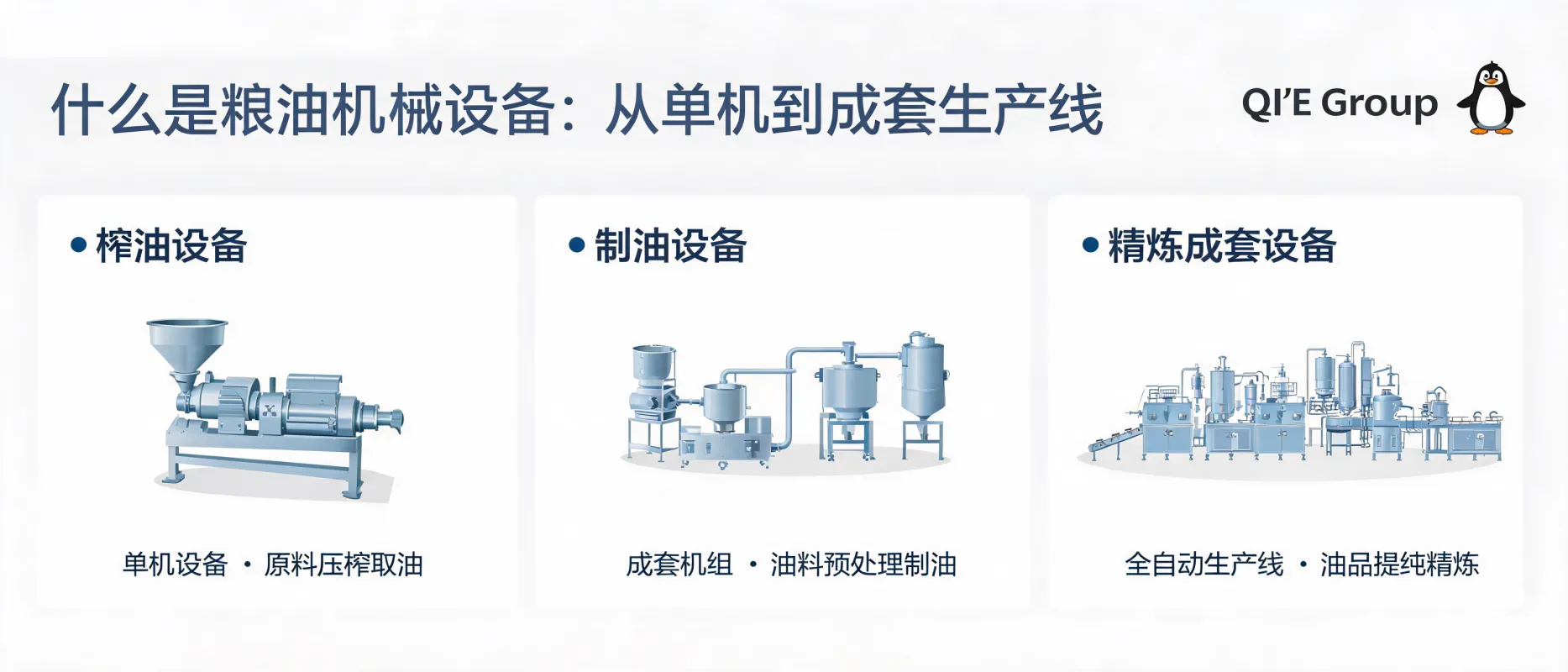
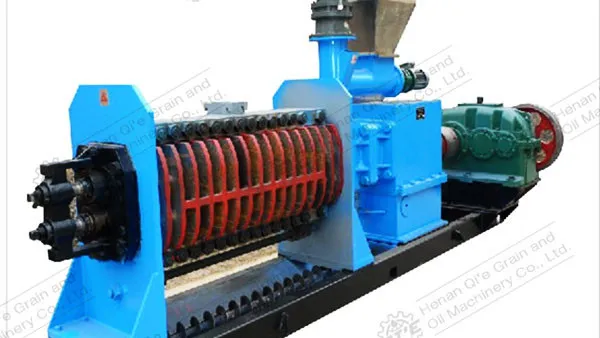
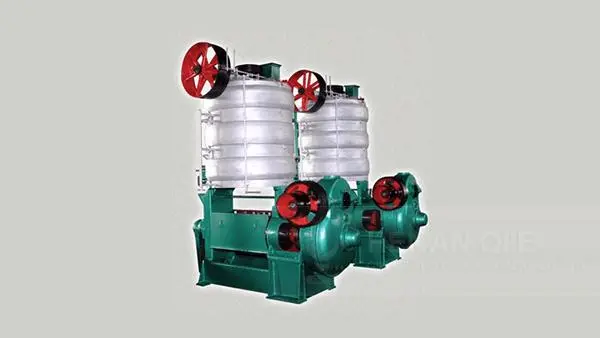
Building an edible oil production line requires more than selecting individual machines—it requires a coherent process flow and an equipment configuration that matches your raw materials, capacity plan, product grade target, and local operating conditions.
This guide from Qi'e Grain and Oil Machinery Co., Ltd. (企鹅集团) explains the typical end-to-end workflow: raw material pretreatment → pressing or solvent extraction → crude oil handling → refining → pre-filling treatment, and how each step maps to key equipment modules for project-oriented implementation.
While the exact line differs by oilseed type (soybean, sunflower, palm kernel, etc.) and product requirement, most projects can be organized into five stable sections. Keeping these sections clearly separated in design helps with quality control, safety management, and future expansion.
Pretreatment is where line stability begins. The goal is to reduce foreign matter, control moisture/temperature, and create a consistent feed for downstream pressing or extraction. The configuration should reflect raw material cleanliness, storage conditions, and targeted throughput.
Implementation note: Pretreatment design should be aligned with the extraction method. For example, a line planning for solvent extraction typically needs more consistent particle size/flake quality than a simple pressing-only line.
The extraction section defines your core equipment set and has major impact on operating cost, safety management, and oil yield. The right choice depends on raw material oil content, project scale, product positioning, and compliance requirements.
Practical approach: Many edible oil projects adopt a combined route based on raw material and scale—e.g., pressing for initial extraction with downstream steps planned to maintain oil quality and production continuity.
Crude oil coming from pressing or extraction is sensitive to impurities, temperature fluctuations, and holding time. Proper handling helps protect refining stability and final edible oil quality.
Edible oil refining converts crude oil into a stable, consumer-ready product. The exact refining sequence and intensity depend on crude oil quality, target oil grade, and local standards. A typical refining line is designed around the following functional steps:
Purpose: reduce gums and free fatty acids to support downstream stability. Equipment typically includes dosing, mixing/reactors, separation/settling or centrifugation modules depending on configuration.
Purpose: remove pigments and trace impurities. Common modules include vacuum bleaching vessel, filter system, and dosing for bleaching earth (based on your chosen process design).
Purpose: reduce odor-causing volatiles and improve sensory quality. Configuration typically focuses on heat exchange, vacuum system design, and stable control to protect product quality.
Refining is a system工程: stable utilities, consistent crude oil supply, and correct equipment matching are often as important as the refining vessels themselves.
Before oil enters a filling/packaging line, pre-filling treatment helps ensure appearance stability and reduces the risk of sediment or haze during storage and transport.
For B2B edible oil plants, implementation success depends on aligning process scope with real constraints. The points below are commonly reviewed during feasibility, engineering, and procurement.
Define oilseed type(s), impurity level, moisture, and target edible oil grade to avoid over/under-configuring equipment.
Confirm desired throughput and whether phased expansion is expected; plan buffers, tankage, and layout accordingly.
Power, steam/thermal oil, water, compressed air, ventilation, and civil works constraints should be verified early.
If solvent extraction is in scope, prioritize process safety design, monitoring, and compliant installation practices.
Plan for commissioning, operator training, and maintenance documentation to reach stable production faster.
Qi'e Grain and Oil Machinery Co., Ltd. (企鹅集团) provides project-oriented equipment for oil pressing equipment, oil production line equipment, and edible oil refining equipment. Our focus is to help clients build a coherent line where each process step has a clear function, interface, and control boundary.
If you share your raw material type, target capacity, and preferred extraction route (pressing / solvent extraction / combined), our engineering team can help you map the process flow to a practical equipment configuration and implementation plan.
 226
|
226
|
 Qi'e Grain and Oil Machinery Co., Ltd.
edible oil production line
oil processing flow
equipment configuration
refining and filling
342
|
rice bran oil deacidification equipment
high-efficiency deacidification system
rice bran oil bleaching technology
energy-saving rice bran oil refining line
edible oil purification equipment
85
|
cold-pressed rapeseed oil
solvent extraction rapeseed oil
rapeseed oil production process selection
oil yield vs nutrition retention
energy consumption and equipment investment
315
|
rapeseed oil pretreatment process
rapeseed oil yield improvement
seed cleaning and destoning
conditioning moisture temperature control
flaking process optimization
99
|
Qi'e Grain and Oil Machinery Co., Ltd.
grain and oil machinery equipment
oil pressing equipment
oil production line equipment
edible oil refining equipment
Qi'e Grain and Oil Machinery Co., Ltd.
edible oil production line
oil processing flow
equipment configuration
refining and filling
342
|
rice bran oil deacidification equipment
high-efficiency deacidification system
rice bran oil bleaching technology
energy-saving rice bran oil refining line
edible oil purification equipment
85
|
cold-pressed rapeseed oil
solvent extraction rapeseed oil
rapeseed oil production process selection
oil yield vs nutrition retention
energy consumption and equipment investment
315
|
rapeseed oil pretreatment process
rapeseed oil yield improvement
seed cleaning and destoning
conditioning moisture temperature control
flaking process optimization
99
|
Qi'e Grain and Oil Machinery Co., Ltd.
grain and oil machinery equipment
oil pressing equipment
oil production line equipment
edible oil refining equipment